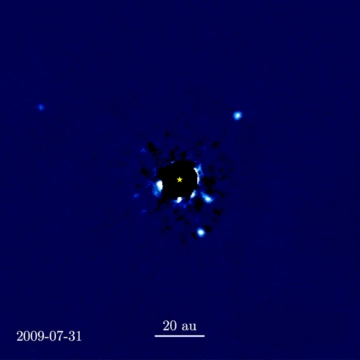
55 Cancri e
First super-Earth discovered around a main sequence star.

55 Cancri e (officially named Janssen) is an exoplanet orbiting the Sun-like star 55 Cancri A. It is the innermost planet in its system, completing an orbit in less than 18 hours, and its extreme proximity to its star makes it one of the hottest known exoplanets.
- mass
- ~8 Earth masses
- diameter
- ~2 Earth diameters
- host_star
- 55 Cancri A
- known_for
- First super-Earth discovered around a main sequence star
Lore & Background
McArthur using the Hobby–Eberly Telescope at McDonald Observatory. The detection was made via radial velocity measurements of its host star. Its transit was confirmed in 2011 by the MOST space telescope, allowing density calculations. The planet's atmosphere has been extensively studied with conflicting results. Early studies suggested hydrogen and helium, but later work failed to confirm this. In July 2014, the IAU launched NameExoWorlds, and in December 2015 the planet was officially named Janssen, after spectacle maker Zacharias Janssen, associated with the telescope's invention. The planet's existence was briefly challenged in 2005 by Jack Wisdom, but later analyses confirmed it.
Reader's Guide
Its discovery marked a milestone in the search for planets between Earth and Neptune in mass. The planet's close orbit and high temperature make it a laboratory for studying extreme planetary environments, including tidal locking, lava oceans, and atmospheric escape. The planet's variable thermal emission, possibly linked to volcanism, adds to its scientific interest. Its naming after Janssen connects it to the history of telescopic observation.
Pioneering the Super-Earth Era
McArthur announced a groundbreaking detection using radial-velocity data collected with the Hobby–Eberly Telescope at McDonald Observatory in Texas. The discovery was announced alongside Gliese 436 b, another close-orbiting hot Neptune. Yet the planet's existence was not settled. The transit was finally confirmed on April 27, 2011, through two weeks of continuous photometric monitoring by the MOST space telescope, validating the corrected period and opening the door to compositional studies.
The Name Janssen
In July 2014, the International Astronomical Union launched NameExoWorlds, an initiative inviting the public to nominate and vote on proper names for select exoplanets and their host stars. Among the candidates was 55 Cancri Ae. In December 2015, the IAU revealed the winning entry: Janssen, a name submitted by the Royal Netherlands Association for Meteorology and Astronomy. The choice honors Zacharias Janssen, a sixteenth-century spectacle maker from the Netherlands who is sometimes credited with an early role in the invention of the telescope. The naming carried a fitting resonance for an exoplanet whose study depends entirely on the light it reflects and emits. By giving the world a human name, the IAU connected a distant, scorching body orbiting a Sun-like star to the long human tradition of looking upward and naming what we find. The name Janssen now appears in official IAU records alongside the designation 55 Cancri Ae, bridging the gap between technical catalog entries and the public's imagination of worlds beyond our own solar system.
A World Forged in Extreme Heat
Its age and closeness make tidal locking virtually certain: one hemisphere permanently bathes in starlight while the other endures perpetual darkness. Those temperatures are sufficient to melt iron. With a mass of roughly eight Earths and a diameter about twice Earth's, the planet sits in a compositional gray zone. Early speculation ranged from a water world to a carbon-rich body in which a third of the mass could be locked in diamond under extreme interior pressure. Ehrenreich noted the absence of hydrogen in the Lyman-alpha transit signature and suggested carbon dioxide might dominate the volatiles instead. The orbital inclination of about 83.6 degrees and a modest obliquity favor gentle inward migration, and the planet may share a plane with its neighbor 55 Cancri Ab.
The Shifting Atmosphere Mystery
For more than a decade, the atmospheric composition of 55 Cancri Ae has defied a single consensus. The earliest analyses pointed toward a hydrogen- and helium-rich envelope, yet subsequent observations failed to confirm that picture and instead favored heavier molecular species, with some researchers proposing nothing more than a thin shroud of vaporized rock. Thermal emission from the planet was noted to be variable, a feature that could hint at volcanic resurfacing on the scorching day-side. Instead, JWST data provided evidence for a substantial atmosphere dominated by carbon dioxide or carbon monoxide, a finding that reshapes models of how such a close-in, high-mass terrestrial world retains its gaseous envelope. The progression—from gaseous giant to water world to carbon planet to a CO/CO2 atmosphere—illustrates how each new instrument refines the picture, leaving 55 Cancri Ae as a living case study in exoplanetary science.
Frequently Asked Questions
How big is 55 Cancri e compared to Earth?
The planet packs roughly eight times Earth's mass into a sphere about twice our planet's diameter. That combination of density and size is what earned it the "super-Earth" label.
How long does it take 55 Cancri e to orbit its star?
A single trip around 55 Cancri A takes fewer than 18 hours—about 0.74 Earth days. Because it sits just 0.015 AU from its host, it is one of the most scorching exoplanets we know of.
Could life exist on 55 Cancri e?
Almost certainly not, given the blistering surface temperature caused by its extreme proximity to its star. Its value to the search for life lies more in showing that rocky super-Earths are common, which helps narrow where we should look for truly habitable candidates.
More in Exoplanets 1-21
Spotted an error? Know more?
This is a living reference — every entry is fact-audited, and reader corrections feed straight into our audit queue. Suggest an edit · See this site's audit record