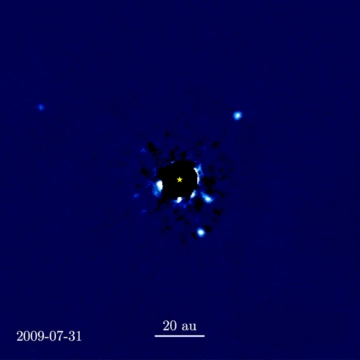
Kepler-22b
First transiting exoplanet found in a Sun-like star's habitable zone.

It was discovered by NASA's Kepler Space Telescope in December 2011 and was the first known transiting planet to orbit within the habitable zone of a Sun-like star, where liquid water could exist on the planet's surface.
- discovery_date
- December 2011
- host_star
- Kepler-22
- constellation
- Cygnus
- radius
- 2.1 Earth radii (as of 2023)
- known_for
- First transiting planet in habitable zone of a Sun-like star
Lore & Background
Confirmation came from the Spitzer Space Telescope and ground-based observations, and the existence of the planet was announced on 5 December 2011. Its radius was initially thought to be 2.4 times that of Earth but was revised to 2.1 Earth radii as of 2023. Its mass and surface composition remain unknown, with upper limits constrained to at most 9.1 Earth masses as of 2023. An Earth-like composition is ruled out to at least 1-sigma uncertainty; the planet is likely a 'water world' with a volatile-rich composition, possibly an ocean planet with a liquid or gaseous outer shell.
Reader's Guide
Kepler-22b holds significance as the first confirmed transiting exoplanet within the habitable zone of a Sun-like star, marking a milestone in the search for potentially life-supporting worlds. Its discovery demonstrated the Kepler Space Telescope's ability to detect Earth-sized planets in temperate orbits. However, its larger radius and likely volatile-rich composition make it more similar to a mini-Neptune or ocean world than to Earth. The planet has spurred SETI research and appears in various media, including a TV series and novels. Its legacy lies in advancing the understanding of exoplanet habitability and inspiring further study of super-Earths and water worlds.
Did You Know?
- Kepler-22b was the first known transiting planet to orbit within the habitable zone of a Sun-like star.
- Its radius is about 2.1 times that of Earth, and its mass is less than 9.1 Earth masses as of 2023.
- No exomoons larger than 0.54 Earth masses have been detected around Kepler-22b.
Discovery & Historical Significance
The announcement was a watershed: for the first time, observers had direct evidence that a planet could orbit a star closely resembling our own at a distance where surface liquid water is physically plausible, fundamentally reshaping the scope of the search for potentially life-sustaining worlds beyond the Solar System.
Physical Nature & Composition
Kepler-22b spans approximately 2.1 Earth radii, a figure revised downward from an earlier estimate of 2.4. (2013) model, and down to at most 9.1 Earth masses by 2023. Radial velocity measurements have excluded an Earth-like rocky composition at at least 1-sigma confidence, pointing instead toward a volatile-rich structure with a liquid or gaseous outer shell, akin to Kepler-11f, one of the smallest known gas planets. Researchers have popularly dubbed the world a "water world," and Natalie Batalha, a scientist on the Kepler project, mused that if the planet is predominantly ocean over a small rocky core, life could conceivably flourish within that water. That speculation has since prompted SETI to rank Kepler-22b among its top candidates in the ongoing search for extraterrestrial biosignatures.
Climate Scenarios & Habitability Prospects
Recent analyses place the probability of the planet residing in the empirical habitable zone—bounded by the recent Venus and early Mars limits—above 95 percent, while its chance of falling within the more conservative, cloud-free radiative-convective habitable zone is under 5 percent. A highly elliptical orbit, if present, would introduce severe seasonal temperature swings.
Orbital Constraints & Observational Frontiers
The eccentricity of the orbit remains unknown; radial velocity campaigns conducted since discovery have yielded only an upper limit rather than a precise value, leaving the true shape of the path uncertain. The Hunt for Exomoons with Kepler (HEK) project scrutinized Kepler photometry for transit-timing and duration variations that might betray an orbiting satellite, but no such signal emerged, effectively ruling out any moon more massive than 0.54 Earth masses. Because the host star is too dim for direct imaging and the planet's mass eludes precise measurement, astronomers continue to depend on indirect detection methods. Each future observation—whether from ground-based radial velocity instruments or next-generation space telescopes—could refine the picture of this enigmatic world and narrow the gap between what is known and what is merely suspected.
More in Exoplanets 1-21
Spotted an error? Know more?
This is a living reference — every entry is fact-audited, and reader corrections feed straight into our audit queue. Suggest an edit · See this site's audit record