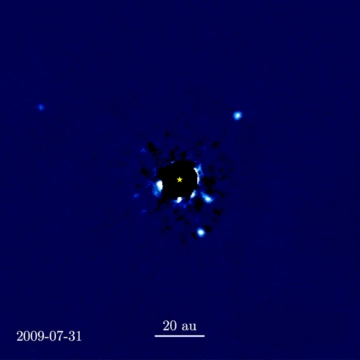
Proxima Centauri b
Closest known exoplanet to the Solar System.

Proxima Centauri b is an exoplanet orbiting within the habitable zone of the red dwarf star Proxima Centauri in the constellation Centaurus. It is the closest known exoplanet to the Solar System, at a distance of about 4.2 light-years from Earth. Announced on 24 August 2016 by the European Southern Observatory, its discovery was a major event in planetology and drew interest to the Alpha Centauri star system.
- discovered
- 24 August 2016
- host_star
- Proxima Centauri
- distance_from_earth
- 4.2 light-years (1.3 parsecs)
- orbital_period
- 11.2 Earth days
- minimum_mass
- 1.06 M🜨
- type
- terrestrial exoplanet (probable)
- constellation
- Centaurus
Lore & Background
Its other properties are poorly understood, but it is probably a terrestrial planet with a minimum mass of 1.06 M🜨 and a slightly larger radius than Earth. The planet orbits within the habitable zone of its star, but it is not known whether it has an atmosphere, which would impact habitability probabilities. Proxima Centauri is a flare star with intense electromagnetic radiation that could strip an atmosphere off the planet. Based on observations with instruments at the European Southern Observatory in Chile prior to 2016, motion anomalies were identified that suggested an exoplanet. In January 2016, the Pale Red Dot project was launched to confirm the hypothetical exoplanet, and on 24 August 2016, the team led by Anglada-Escudé announced the discovery. Proxima Centauri b is likely tidally locked to its host star, which would mean the same side always faces the star. It is unclear whether habitable conditions can arise under such circumstances. The planet may not be tidally locked if its eccentricity is higher than 0.1–0.06, or if it is not symmetrical.
Reader's Guide
Proxima Centauri b is significant as the closest known exoplanet to Earth, offering a unique target for robotic space exploration and study. Its discovery confirmed that red dwarf stars, the most common type of star, frequently host planets in their habitable zones. The planet's proximity allows for detailed observation and potential future missions, though its habitability remains uncertain due to the host star's flare activity and the unknown presence of an atmosphere. As of 2023, it is believed to be the best-known exoplanet to the general public. The planet's existence has also spurred interest in the Alpha Centauri system as a whole, and its discovery was a milestone in planetology. However, many of its properties—such as true mass, radius, composition, and orbital eccentricity—remain poorly constrained or disputed, reflecting the challenges of studying exoplanets around faint, active stars.
Did You Know?
- Proxima Centauri b orbits its star every 11.2 Earth days at a distance over 20 times closer than Earth is to the Sun.
- The planet's minimum mass is 1.06 M🜨, but its true mass could be higher if the orbital inclination is not edge-on.
The Long Road to Confirmation
The story of Proxima Centauri d's discovery is one of patience and incremental progress. The planet's first whisper appeared not as a deliberate target but as a faint 5.15-day oscillation hiding within radial velocity measurements collected by the Very Large Telescope. Those data had originally been gathered in 2020 for a separate investigation into the mass of Proxima b, yet the subtle periodic signal persisted in the numbers. At that stage, the detection rested on the ESPRESSO spectrograph on the VLT, with a weaker two-sigma hint from the HARPS instrument at La Silla Observatory—enough to intrigue the community but short of the independent confirmation standard. Some researchers argued the planet was already effectively verified because multiple analytical approaches to the same radial velocity dataset all pointed to the same periodicity.
A Tiny World in a Tight Orbit
Proxima Centauri d is a sub-Earth world, weighing at least a quarter of Earth's mass—roughly double what Mars tips the scales at. This makes it both the innermost and the least massive planet yet identified in the Proxima Centauri system. Because the planet sits so close to its star and its year is so brief, powerful tidal forces almost certainly lock one hemisphere permanently facing the star. Since the radial velocity method yields only a minimum mass, the true figure depends on the orbital inclination angle.
Heat, Ice, and a Powerful Magnetic Shield
Despite its tiny size, Proxima Centauri d presents a fascinating puzzle for habitability researchers. Yet the extreme day-night contrast of a tidally locked world leaves open the theoretical possibility that polar regions could cool enough to sustain liquid water. In May 2026, a dedicated study of the Proxima Centauri system revealed evidence of star-planet magnetic interaction involving both Proxima d and Proxima b, strongly implying that each planet hosts its own magnetic field. Proxima d's estimated field strength sits near 16 gauss, a value dramatically exceeding Earth's own 0.25 to 0.65 gauss. A comparable magnetic coupling had previously been documented at YZ Ceti b, making Proxima d a second such case and offering a rare window into how small, close-in worlds interact electromagnetically with their host stars.
The Neighbourhood Record-Holder
Proxima Centauri d occupies a uniquely privileged position in the catalogue of known worlds. Its host star, Proxima Centauri, is the closest star to the Sun and forms part of the Alpha Centauri triple system, placing the entire planetary family at roughly 4.2 light-years—about 1.3 parsecs, or 40 trillion kilometres (25 trillion miles)—within the constellation of Centaurus. Together with one or two companion planets in the same system, Proxima d ranks among the closest known exoplanets to the Solar System. This extraordinary proximity makes the planet a uniquely valuable target for future observational campaigns, as the signal-to-noise advantages available at such a short distance are simply unattainable for the vast majority of other exoplanets. The fact that it orbits a red dwarf rather than a Sun-like star means the stellar spectrum bathing the planet differs markedly from what Earth receives, adding a distinct dimension to any future atmospheric or surface investigations. For the broader exoplanet community, Proxima d stands as the nearest confirmed sub-Earth world, a concrete and tangible benchmark that anchors the statistical picture painted by more distant detections.
More in Exoplanets 1-21
Spotted an error? Know more?
This is a living reference — every entry is fact-audited, and reader corrections feed straight into our audit queue. Suggest an edit · See this site's audit record