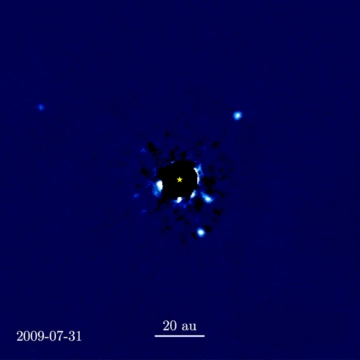
HD 189733 b
First exoplanet with a thermal map and notable atmospheric studies.

HD 189733 b is an exoplanet located in the constellation of Vulpecula, approximately 64.5 light-years from the Solar System. Discovered by astronomers in France on October 5, 2005, via the transit method, it is a hot Jupiter with a mass about 13–14% higher than Jupiter's (1.13–1.14 Jupiter masses) and a radius 11.4% greater. It orbits its host star every 2.2 days at an orbital speed derived from its orbital parameters, making it inhospitable to extraterrestrial life. As the closest transiting hot Jupiter to Earth, it has been extensively studied for its atmospheric properties.
- mass
- 13–14% higher than Jupiter (1.13–1.14 Jupiter masses)
- orbital_speed
- Derived from orbital parameters (not a widely established canonical value)
Lore & Background
HD 189733 b was discovered by a French team on October 5, 2005, through transit observations. The following day, the discovery was announced, and Doppler spectroscopy confirmed the planet, with the Rossiter–McLaughlin effect detected during transit. The planet's mass is widely accepted at about 1.13–1.14 Jupiter masses (13–14% higher than Jupiter), with an orbital speed derived from its orbital parameters.
Reader's Guide
HD 189733 b holds significance as the first exoplanet to have its thermal map constructed, its overall color determined (deep blue), and its transit viewed in the X-ray spectrum. It was also the first exoplanet confirmed to have carbon dioxide in its atmosphere. The planet's weather includes raining molten glass, and it exhibits winds up to 8,700 km/h from day to night side. In July 2014, NASA announced its very dry atmosphere. The blue color, likely due to Rayleigh scattering, was confirmed in 2013, though polarimetric measurements have been disputed. The planet is tidally locked and has no satellites or ring system.
Did You Know?
- HD 189733 b was the first exoplanet to have its thermal map constructed.
- The planet's weather includes raining molten glass.
- It was among the first exoplanets with carbon dioxide detected in its atmosphere, though not the first confirmed.
Discovery Through Transit and Spectroscopy
In October 2005, a group of French astronomers made a landmark announcement: a new world was circling the star HD 189733 in the constellation Vulpecula, roughly 64.5 light-years from our own Sun. The detection relied on the transit method, in which the planet periodically slides across the stellar disk and dims its light. Before photometric confirmation arrived, real-time radial velocity measurements had already picked up the Rossiter–McLaughlin effect, a subtle wavelength shift produced as the planet blocks portions of the rotating star. The following year, Drake Deming and colleagues used secondary-eclipse photometry to capture strong infrared thermal emission from the planet's dayside. By early 2007, Carl Grillmair and his team at NASA's Spitzer Science Center had extracted detailed infrared spectra, a result published in the Astrophysical Journal Letters alongside parallel work on HD 209458 b. Together, these two worlds became the first exoplanets ever to be directly spectroscopically characterized, a distinction that has kept them at the center of atmospheric research ever since.
A World of Glass Rain and Dry Air
Despite its resemblance to Jupiter in bulk size, HD 189733 b harbors an atmosphere unlike anything in our own solar system. Carbon dioxide has been confirmed as a constituent of the atmosphere, while high-resolution observations with the UVES spectrograph on the Very Large Telescope identified atomic sodium and probed further thermal properties. A condensate of magnesium silicate, with particle sizes on the order of ten to the minus second through minus first micrometers, appears to float in the haze. In July 2014, NASA reported that the planet's atmosphere is remarkably dry, a finding shared with HD 209458 b and WASP-12b. Early models classified the atmosphere as pL type, lacking the temperature-inversion stratosphere seen in cooler L-dwarf objects, and the apparent absence of a cooler shaded layer beneath the outer envelope supports that picture.
The First Blue Planet
One of the most celebrated achievements in exoplanet science came when researchers determined the overall visible color of HD 189733 b. The polarization signal indicated that the scattering atmosphere extends more than 30 percent beyond the opaque disk seen during transit. Follow-up work in 2011 showed the albedo is markedly stronger in blue wavelengths than in red, a signature consistent with Rayleigh scattering and molecular absorption at longer wavelengths. By 2013 the deep cobalt-blue hue had been confirmed through a second independent technique, making this the first planet whose overall color was established by two different methods. However, two later teams employing more sensitive polarimeters cast doubt on the original polarimetric measurements, placing upper limits on the signal and leaving the exact mechanism under debate.
X-ray Shadows and a Leaking Atmosphere
HD 189733 b has also pushed the boundaries of what astronomers can observe in extreme wavelengths. In July 2013, NASA reported the first-ever detection of a planet's transit in the X-ray spectrum. The result was striking: the planet's extended atmosphere absorbs three times more X-ray flux than visible light during the crossing, revealing a vast, tenuous envelope that stretches far beyond the opaque core. It was the second world, after HD 209458 b, for which such atmospheric escape had been measured. The planet's blistering 2.2-day orbit at speeds near 152 kilometers per second, combined with tidal locking that fixes one hemisphere in perpetual daylight, creates the conditions that drive this continuous hemorrhage of gas into space.
Frequently Asked Questions
What is HD 189733 b?
It is a hot Jupiter exoplanet roughly 64.5 light-years away in the constellation Vulpecula, circling its parent star in a mere 2.2 days.
How was HD 189733 b discovered?
French astronomers spotted it on October 5, 2005, by the transit method—detecting the brief dip in its host star's brightness as the planet crossed in front.
How does HD 189733 b compare in size to Jupiter?
It is a slightly beefed-up version of our solar system's giant: about 11 percent more massive and roughly 11 percent wider in radius.
Why is HD 189733 b a landmark in exoplanet research?
As the closest transiting hot Jupiter to Earth, it was the first exoplanet to receive a full thermal map and the first where carbon dioxide was confirmed in its atmosphere, making it a go-to target for atmospheric characterization.
Could life exist on HD 189733 b?
No—its blistering orbital speed of 152 km/s and scorching close-in orbit make it far too extreme to support any form of extraterrestrial life.
More in Exoplanets 1-21
Spotted an error? Know more?
This is a living reference — every entry is fact-audited, and reader corrections feed straight into our audit queue. Suggest an edit · See this site's audit record