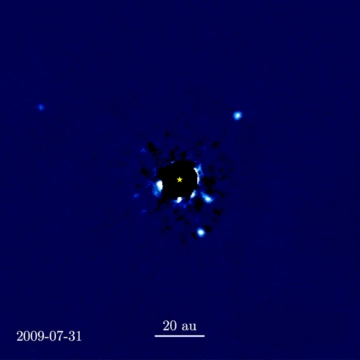
HR 8799 system
First directly imaged multiple-planet system with four giant planets.

The star is approximately 42 million years old, with 1.4 times the Sun's mass and 5 times its luminosity, and is surrounded by a debris disk and at least four massive planets. It is unique as the only known star simultaneously classified as a Gamma Doradus variable, a Lambda Boötis star, and a Vega-like star.
- type
- Star system
- constellation
- Pegasus
- age
- ~42 million years (best accepted value 30 million years)
- stellar_classification
- F0VkA5mA5 V; λ Boo
- known_for
- First directly imaged multiple-planet system; four massive planets (b, c, d, e) with confirmed orbital motion
Lore & Background
Its luminosity varies as a Gamma Doradus variable due to non-radial pulsations. The star's age is debated, with asteroseismology suggesting 1.1–1.4 billion years, but older ages are disfavored because they would imply higher planet masses and unstable orbits; the best accepted value is 30 million years, consistent with membership in the Columba association. The star's surface shows low iron abundance (28–30% of solar) and sulfur abundance at 35% of solar, while carbon and oxygen are slightly above solar levels.
Reader's Guide
The four planets (e, d, c, b) orbit at distances 2–3 times those of Jupiter, Saturn, Uranus, and Neptune, respectively, and receive similar stellar radiation due to the star's higher luminosity. The system may be in a 1:2:4:8 orbital resonance, and the planets show varied atmospheric compositions, including clouds and non-equilibrium CO/CH4 chemistry. A debris disk exists both inside the innermost planet's orbit and around the outermost planet, with room for terrestrial planets in the inner system. The star's rotational inclination may be misaligned with the planets' orbital plane, though recent photometric analysis suggests consistency.
Did You Know?
- The star's iron abundance is only 28–30% of the solar value, while sulfur is about 35% of solar.
- The system may be in a 1:2:4:8 orbital resonance, similar to the Laplace resonance among Jupiter's moons.
Frequently Asked Questions
How many planets orbit HR 8799?
Four massive planets—designated b, c, d, and e—have been confirmed around this star, each showing verified orbital motion. The system also hosts a surrounding debris disk, adding to its complexity.
How old is the HR 8799 system?
The star is estimated to be roughly 42 million years old, making it a true infant compared to our 4.6-billion-year-old Sun. That youth is a major reason its planets are still hot and bright enough to be captured in direct telescope images.
Why is HR 8799 so important in astronomy?
It holds the distinction of being the first extrasolar system in which multiple planets were directly imaged rather than detected only through indirect signals. It is also the only known star simultaneously classified as a Gamma Doradus variable, a Lambda Boötis star, and a Vega-like star.
How does HR 8799 compare to our Sun?
The star carries about 1.4 times the Sun's mass yet radiates roughly five times as much light, earning it a hot F-type spectral classification. Its high luminosity and youth are key factors that make the four giant planets visible to ground-based and space telescopes.
More in Exoplanets 1-21
Spotted an error? Know more?
This is a living reference — every entry is fact-audited, and reader corrections feed straight into our audit queue. Suggest an edit · See this site's audit record