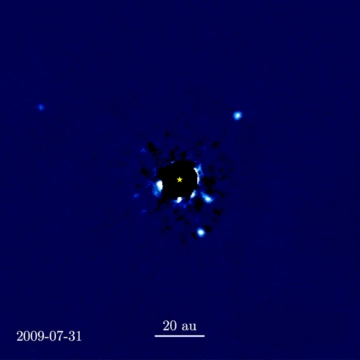
Super-Earths
Exoplanets more massive than Earth but lighter than ice giants.

Super-Earths are a class of exoplanets defined by their mass, which is higher than Earth's but substantially below that of Uranus and Neptune (14.5 and 17.1 Earth masses, respectively). The term refers only to mass and does not imply anything about surface conditions, composition, or habitability. Some astronomers also use the term for planets with radii between about 1.25 and 2 Earth radii, a definition made by the Kepler space telescope personnel.
- Definition
- Mass higher than Earth's, below ~10 Earth masses; radius 1.25–2 Earth radii (Kepler definition)
- First discovered
- 1992, around pulsar PSR B1257+12 by Aleksander Wolszczan and Dale Frail
- First in habitable zone
- 2007, Gliese 581c (at least 5 Earth masses)
- Smallest confirmed by radial velocity (a
- Gliese 581e (1.9 Earth masses)
- Notable detection methods
- Radial velocity, gravitational microlensing, transit (Kepler)
Lore & Background
The first super-Earths were discovered in 1992 by Aleksander Wolszczan and Dale Frail around the pulsar PSR B1257+12. The two outer planets, Poltergeist and Phobetor, have masses approximately four times Earth's. Gliese 581c, with a mass of at least 5 Earth masses, is on the warm edge of the habitable zone, though subsequent research suggested it likely suffered a runaway greenhouse effect like Venus. Gliese 581e (1.9 Earth masses) was at the time the smallest exoplanet around a normal star.
Reader's Guide
Super-Earths represent a critical category in exoplanet science because they bridge the gap between terrestrial planets and gas giants. Their study has revealed that planets with masses between Earth and Neptune are common in the galaxy, challenging earlier assumptions about planetary system architectures. The term's focus on mass rather than composition or habitability has allowed astronomers to classify a wide range of worlds, from rocky planets like COROT-7b to those that may be 'mini-Neptunes' with thick atmospheres. The Kepler mission's radius-based definition further refined the category, enabling statistical studies of planet occurrence rates. Disputes over specific planets, such as Gliese 581g (questioned by another team and listed as unconfirmed), highlight the challenges of detection and confirmation. The discovery of super-Earths in habitable zones, like Gliese 581c and Kepler-22b, has fueled interest in the potential for liquid water and life, though many such planets may be too hot or have runaway greenhouse effects. Overall, super-Earths have reshaped our understanding of planetary formation and the diversity of worlds beyond the Solar System.
Did You Know?
- The first super-Earths were discovered in 1992 around the pulsar PSR B1257+12 by Aleksander Wolszczan and Dale Frail.
More in Exoplanets 1-21
Spotted an error? Know more?
This is a living reference — every entry is fact-audited, and reader corrections feed straight into our audit queue. Suggest an edit · See this site's audit record